 qbrin
qbrinIndustrial & physical AI · 3 of 3
The trust layer for physical AI: robotics, drones, energy, and biotech
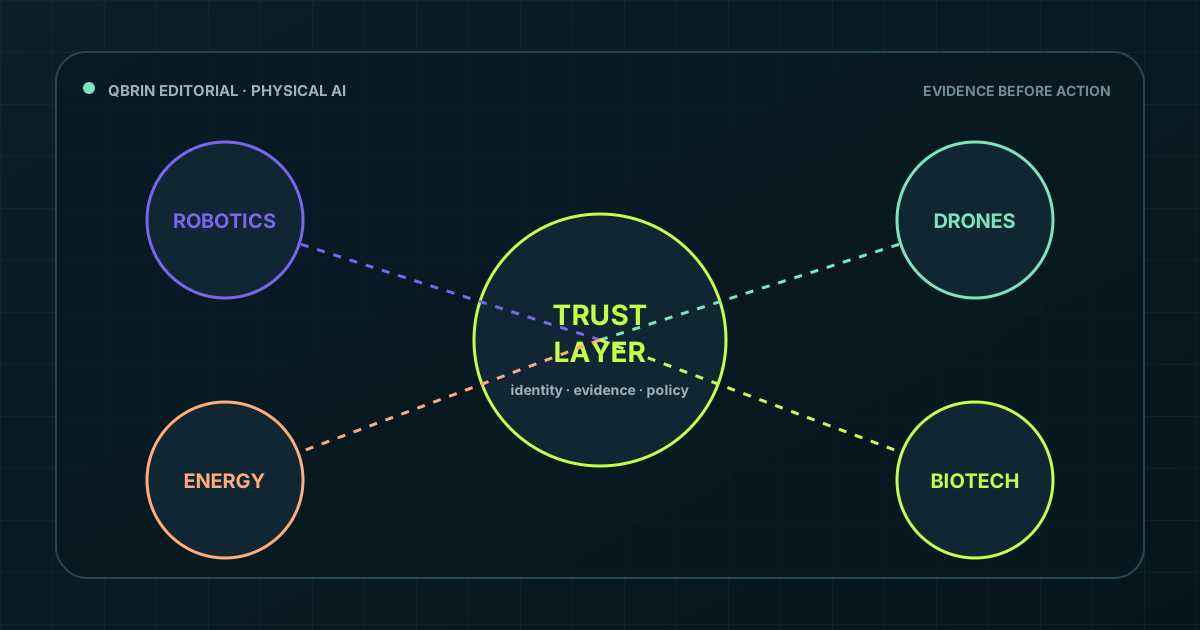
Physical AI changes the cost of a hallucination. A wrong sentence can become motion, power flow, material change, or a biological workflow.
The sectors are different, but the trust problem repeats. An agent observes partial evidence, forms a claim about the world, and proposes an action. A verification layer can make the transition from claim to action explicit.
The reusable five-part pattern
Identity — which agent, operator, vehicle, or service is making the request?
Evidence — which signed, timestamped, permissioned sources describe the current state?
Verification — what claims do those sources support, contradict, or leave unresolved?
Policy — which action is permitted in this mode, place, and risk class?
Trace — can the full boundary decision be replayed and audited?
This pattern is not a replacement for control theory, robotics planning, process safety, or domain regulation. It is connective tissue around AI-mediated decisions.
Robotics: verify state before motion
A warehouse or field robot may combine perception, maps, task instructions, fleet status, and human requests. The trust layer can check whether the referenced object exists, the map is current, the route remains allowed, and the agent's role permits the movement.
Start with task allocation, exception handling, and recovery suggestions. Keep low-level collision avoidance and emergency stops local and deterministic. Useful boundary states include proceed, re-observe, slow, hold, and request a human.
Drones: bind claims to time, vehicle, and mission phase
A drone's evidence expires quickly. Wind, battery, geofence, link quality, and navigation health all depend on time and mission phase. A claim such as “safe to continue” should carry the observations and policy that made it true.
qbrin's recorded PX4/Gazebo simulation demonstrates a HOLD-and-recover pattern in simulation. A real deployment would require separate hardware testing, deterministic fallback, regulatory review, and explicit command authority.
Energy: distinguish a valid command from a justified one
Energy systems already have protection and dispatch rules. AI can help with alarm correlation, maintenance, forecasting, restoration planning, and operator decision support. The trust layer can require current topology, equipment state, forecast provenance, and authorization before a proposed switching or dispatch action advances.
A model should not bypass established protection. The published qbrin grid experiment is a controlled illustration of why mechanical command validity and evidence-backed intent are different.
Biotech: provenance and approval are part of the fact
In biotechnology and laboratory operations, a result depends on sample identity, protocol version, instrument state, calibration, chain of custody, and reviewer approval. A trust layer could support literature review, deviation triage, batch-record assistance, instrument troubleshooting, and protocol-aware recommendations.
It should not turn a cited paper into permission to change a validated process. Evidence quality, regulated approval, and execution authority remain separate gates, with domain experts in the loop.
One architecture, different risk rhythms
| Sector | Evidence half-life | Good first boundary | Never replace |
|---|---|---|---|
| Robotics | Milliseconds to minutes | Task and exception approval | Emergency stop and collision safety |
| Drones | Milliseconds to mission phase | Replanning and contingency recommendation | Certified flight protections |
| Energy | Cycles to planning horizons | Operator decision support | Protection relays and operating authority |
| Biotech | Run, batch, or protocol revision | Provenance and review workflow | Validated process and regulated approval |
A responsible path from insight to autonomy
Simulate. Create scenarios including missing and contradictory evidence. Shadow. Produce recommendations without operational authority. Supervise. Let a human approve bounded, reversible actions. Constrain. Encode identity, scope, rate, environment, and rollback. Expand. Increase autonomy only where measured false acceptance and recovery behavior support it.
What “industrial revolution” should mean here
The credible opportunity is not a claim that one product has transformed every sector. It is a change in how autonomy is introduced: systems earn authority by carrying their evidence, respecting policy, and stopping cleanly when the world is uncertain.
Physical AI becomes more deployable when “why” and “may” are evaluated before “do.”
Comments
Sign in with GitHub to reply. Threads live in a public repository, so anyone can read them without an account.