 qbrin
qbrinIndustrial & physical AI · 1 of 3
A verification layer for space and aerospace AI: from telemetry to permission
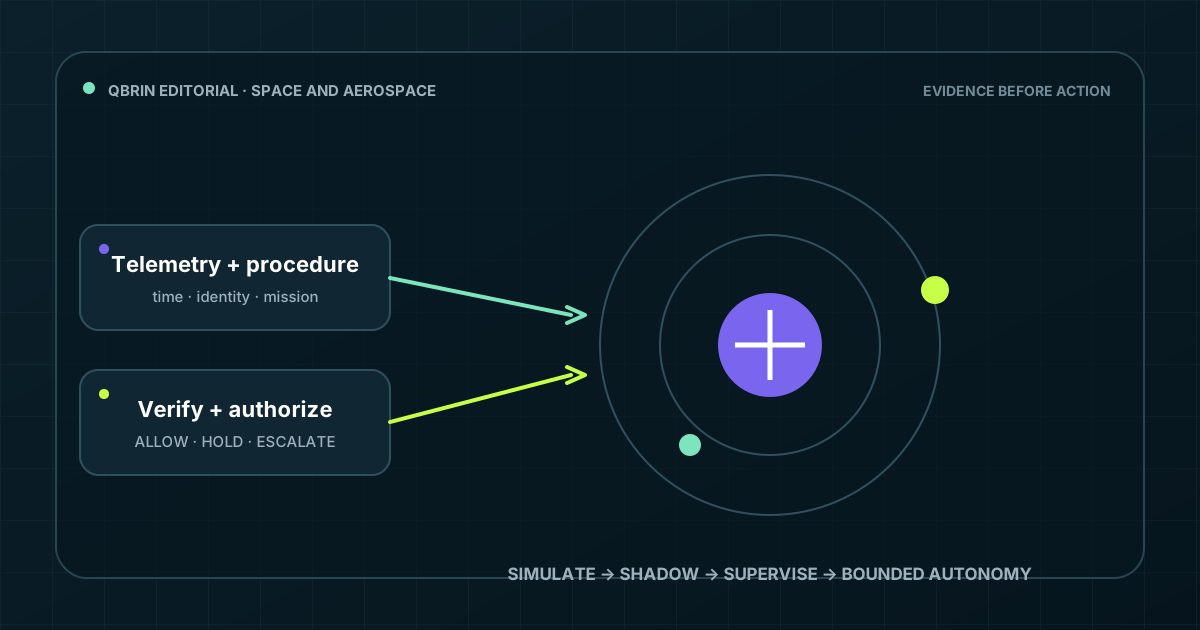
In space and aerospace systems, the expensive mistake is not only a wrong prediction. It is a plausible recommendation that crosses into action without enough evidence, the right authority, or a recoverable path.
That is where a verification layer can be valuable: between the AI that interprets mission context and the system that can change a route, configuration, schedule, or actuator state.
The mission-assurance pattern
An AI assistant may combine telemetry, procedures, weather, vehicle configuration, notices, maintenance history, and mission rules. Retrieval can surface the relevant material. The trust layer then asks three questions before a consequential recommendation crosses the boundary:
- Are the required sources present, current, and bound to the correct vehicle and mission?
- Do those sources support the diagnosis or proposed contingency?
- Is this agent authorized to recommend, schedule, simulate, or execute the action?
The answers can lead to ALLOW, HOLD, DENY, or ESCALATE. The important property is that uncertainty becomes an explicit control state, not an adjective buried in model prose.
Where the layer could fit
| Workflow | Evidence to bind | Potential boundary |
|---|---|---|
| Mission planning | Vehicle limits, route, airspace, weather, payload constraints | Reject a plan whose assumptions are stale or incomplete |
| Ground operations | Telemetry, procedures, command history, mission phase | Require the correct evidence and approval for a command |
| Anomaly triage | Sensor history, fault trees, maintenance records, software version | Separate supported diagnosis from ranked speculation |
| Maintenance | Inspection evidence, part life, configuration, sign-offs | Prevent closure when required proof is missing |
| Fleet learning | Cross-mission events with provenance | Keep one vehicle's observation from becoming fleet-wide fact without review |
Why telemetry is not self-interpreting
A measurement can be valid while the conclusion drawn from it is not. Altitude may be within range but stale. A fault code may be real but attached to the wrong software configuration. Two sensors may disagree because they update at different rates. Verification has to preserve time, identity, units, mode, and provenance—not only values.
For real-time control loops, latency and determinism often rule out a remote semantic system. The verification layer is more naturally placed around supervisory decisions, mission replanning, operator recommendations, and bounded autonomous actions, with certified local safety controls remaining authoritative.
What the drone simulation demonstrates
qbrin's recorded ten-minute PX4 and Gazebo mission shows one useful behavior: when an evidence sample was incomplete, the system returned HOLD; when the evidence recovered, the mission continued, returned, landed, and disarmed. The route was offline and the telemetry live within the simulation stack.
This is evidence of an integration pattern in a simulator. It is not evidence of hardware-in-the-loop validation, environmental qualification, DO-178C compliance, command authority in a flight organization, or any other certification.
Design requirements for a serious aerospace pilot
Run offline when connectivity is not assured. Timestamp and sign evidence. Define maximum data age per claim. Fail to a known vehicle state. Keep the flight computer's certified protections independent. Make every model-generated claim inspectable. Separate recommendation authority from command authority. Rehearse degraded modes and rollback. Record enough context to replay every ALLOW and HOLD.
Begin in simulation, then shadow a human-operated workflow. Compare the system's proposed boundary decisions with mission specialists. Only after the error modes are understood should a narrow, reversible action be considered.
The opportunity
Space systems are accumulating more autonomy because communication is delayed, operators are scarce, and fleets are growing. The opportunity is not to replace the discipline that makes aerospace safe. It is to carry that discipline into AI-mediated decisions: explicit evidence, explicit authority, and an explicit stop when either is missing.
Comments
Sign in with GitHub to reply. Threads live in a public repository, so anyone can read them without an account.