 qbrin
qbrinInside qbrin · 2 of 6
Inside qbrin's trust-layer architecture: knowledge, verification, and control
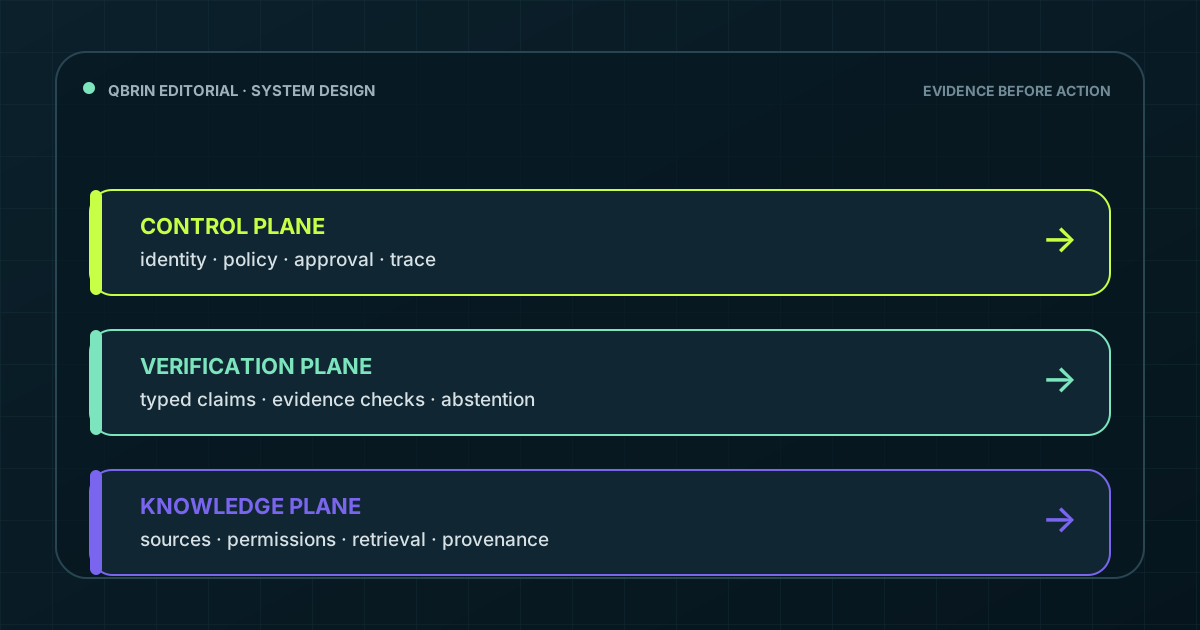
A trustworthy agent stack has to answer three separate questions: What does the organization know? Which claims does that knowledge support? What is this agent allowed to do?
Trying to solve all three inside one prompt creates a system that is difficult to test and almost impossible to govern. A more useful way to understand qbrin is as three connected planes with explicit boundaries between them.
Plane one: governed knowledge
The knowledge plane brings together the material an organization already uses—documents, conversations, email, decisions, and content added through the API. Public qbrin documentation describes extraction, chunking, embedding, entity extraction, and source-aware responses. Those are retrieval mechanics, but governance is the load-bearing part.
Every piece of evidence should retain its origin, freshness, and access context. A sales document, an incident channel, and a legal policy may all mention the same customer while carrying different authority and permissions. Retrieval quality without permission fidelity is a data leak with good recall.
Plane two: claim verification
The verification plane sits between retrieval and delivery. It does not ask only whether a passage resembles the question. It asks whether the evidence supports the particular claim the system wants to return.
| Check | Question | Failure response |
|---|---|---|
| Presence | Is the entity or value actually in the records? | Abstain or correct the premise |
| Entailment | Does the source support this exact statement? | Remove or narrow the claim |
| Freshness | Has a newer fact superseded this one? | Prefer the current record |
| Provenance | Can the reader inspect the supporting source? | Do not present it as verified |
This is an inline control, not merely an analytics event. The result of the check changes what can leave the system.
Plane three: control and action governance
An agent that only answers questions has one kind of risk. An agent that can create a ticket, change a setpoint, move a robot, or call a payment API has another. The control plane must combine evidence with identity and policy.
Useful controls include scoped credentials, least privilege, action classes, environment boundaries, approval rules, rate limits, and a durable trace. The public qbrin agent material describes identity, policy, audit, observability, and containment. Those controls should remain explicit even when the underlying model changes.
The boundary between planes is the product
The planes are valuable because they can fail independently. Retrieval can find nothing. Verification can reject a weak citation. Policy can deny an otherwise well-supported action. A mature system records which boundary stopped the request and why.
Why observability alone is not enough
A trace is essential for diagnosing what happened, but a trace after an unsafe action is an excellent autopsy. The architecture needs both visibility and an inline decision point. Observability explains; verification and authorization constrain.
Evaluation plays another role: it tells you how a configuration behaves across a dataset before and after changes. qbrin's trust layer is intended to operate during the live request. The categories work together, but they are not substitutes. See the full comparison in qbrin versus ordinary RAG, observability, and evaluation tools.
A practical deployment sequence
Start by connecting a narrow, authoritative source set. Define the claims that must be cited and the cases that must abstain. Run in shadow mode to measure unsupported claims and permission mismatches. Add human review for consequential actions. Only then grant a bounded action scope, with rollback and an audit trail.
This sequence treats autonomy as earned capability. The system graduates because the evidence improves—not because a demo looks smooth.
Comments
Sign in with GitHub to reply. Threads live in a public repository, so anyone can read them without an account.