 qbrin
qbrinInside qbrin · 5 of 6
qbrin vs ordinary RAG, LLM observability, and evaluation tools
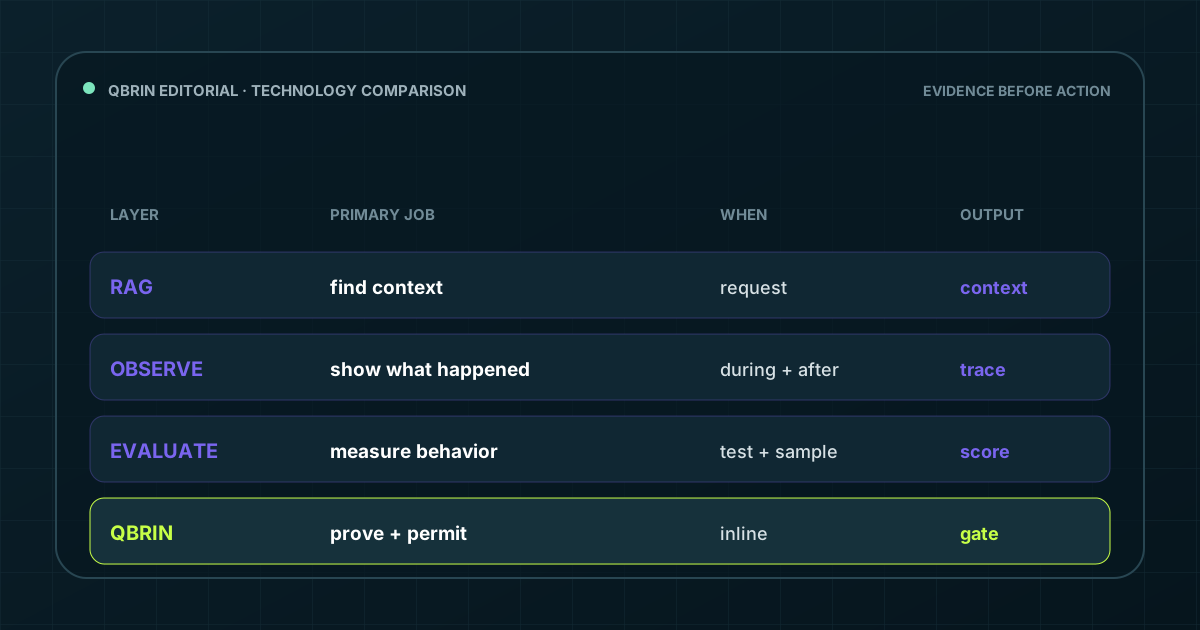
qbrin overlaps with several familiar AI infrastructure categories, but overlap is not identity. The clearest comparison starts with the job each category is hired to do.
Ordinary RAG: bring relevant context to the model
Retrieval-augmented generation finds passages related to a question and places them in the model's context. A good RAG stack improves recall, reduces dependence on model memory, and gives the answer access to private or current information.
What ordinary RAG does not automatically provide is a claim-level decision boundary. A retrieved passage can be relevant but fail to support the precise answer. The generator may combine two sources incorrectly, accept a false premise, or cite a paragraph that never states the number it produced.
LLM observability: show what happened
Observability platforms record prompts, retrievals, tool calls, latency, cost, errors, and traces. They are indispensable for debugging and operations. They help a team answer: Which component failed? What changed after the release? Where are cost and latency coming from?
The category's core job is visibility. Some observability products also support online checks and guardrails, but a trace by itself does not prevent a weakly supported claim from leaving or an unauthorized action from executing.
Evaluation tools: measure behavior across a test set
Evaluation systems run datasets, human reviews, heuristics, or model-based judges to compare versions and detect regressions. They answer: How often did this configuration succeed? Did retrieval improve? Did the new prompt increase false acceptance?
Evals are a measurement loop. They can run before release, in continuous testing, or on sampled production traffic. They do not necessarily sit in every live request path.
qbrin: decide whether this claim or action crosses the boundary
qbrin is positioned as a live trust layer. It uses retrieved evidence, verifies what a response claims, preserves citations, and can return an abstention instead. Around agents, the same architecture extends to identity, policy, trace, and containment.
| Category | Primary question | Typical timing | Directly changes output? |
|---|---|---|---|
| Ordinary RAG | What context is relevant? | During a request | Indirectly, through context |
| Observability | What happened and why? | During and after | Usually no; some tools add gates |
| Evaluation | How well does the system perform? | Before, after, or sampled | Not usually per request |
| qbrin trust layer | Is this supported and permitted now? | Inline | Yes: answer, narrow, abstain, hold, or escalate |
These are layers, not winner-take-all categories
A strong qbrin deployment can still use vector search, a reranker, an observability platform, and an evaluation suite. The trust layer consumes retrieval evidence, emits traces worth observing, and needs evals to tune its thresholds. Replacing any category should be a workload decision, not a slogan.
The honest question is where the live responsibility sits. If a generated claim is unsupported, which component can stop it? If an action is outside policy, which component returns DENY before the tool call? If the system abstains too often, which evaluation reveals why?
How to compare systems fairly
Use the same corpus, permissions, answer model, question set, and scoring definitions. Include answerable questions and traps whose answers are absent. Report coverage next to accuracy, separate answered accuracy from raw accuracy, audit citations for actual support, and disclose whether competitor numbers are vendor-published or reproduced.
qbrin's own benchmark report follows some of this discipline and publishes losses as well as leads; it is still a first-party report. Our detailed reading is in How to read qbrin's benchmark results without the marketing fog.
Choose the missing control
If your problem is poor retrieval, improve retrieval. If it is invisible latency and cost, add observability. If releases regress, build evals. If unsupported claims or out-of-policy actions are reaching users and tools, add an inline verification and authorization boundary.
The categories are complementary. The useful distinction is not the label on the tool; it is whether the system can prove, observe, measure, or prevent the failure you care about.
Comments
Sign in with GitHub to reply. Threads live in a public repository, so anyone can read them without an account.