 qbrin
qbrinInside qbrin · 6 of 6
How to read qbrin's benchmark results without the marketing fog
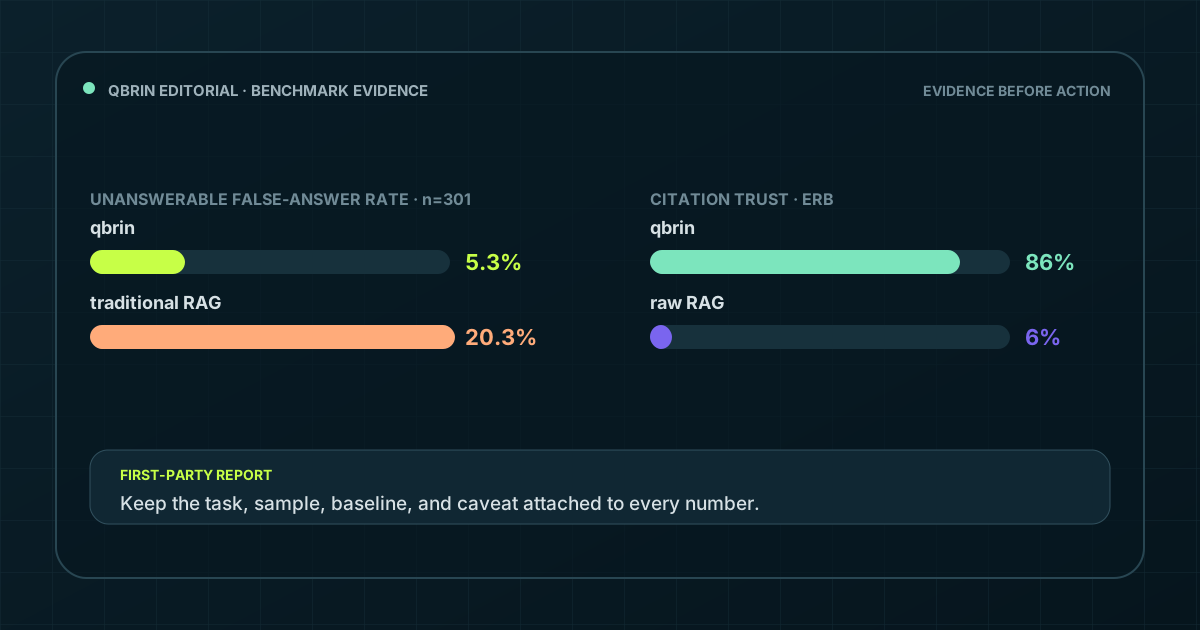
A benchmark should narrow uncertainty, not manufacture certainty. The useful way to read qbrin's numbers is to preserve the task, sample, baseline, and trade-off attached to each one.
This guide summarizes the qbrin Benchmark Report dated June 23, 2026. It is a first-party report, not an independent certification. The document says its competitor figures are either published results or faithful reruns on identical data and judging; that distinction should stay attached when the results are repeated.
The load-bearing result: fewer false answers when no answer exists
On 301 multi-hop questions with no valid answer, the report lists a 5.3% false-answer rate for qbrin. The listed baselines are 20.3% for traditional RAG, 17.6% for hybrid RAG, and 18.9% for reranking. On that test, qbrin's false-answer rate is about one quarter of the traditional-RAG rate.
The report also lists 0 confidently wrong answers across 281 Enterprise RAG Benchmark traps: 131 near-miss traps and 150 absent-value traps. That result is compelling, but it belongs to qbrin's own enterprise benchmark and should not be generalized to every corpus without a matched run.
Decision accuracy and citation trust
On 500 real-company questions—470 answerable and 30 unanswerable—the report gives qbrin 88.4% in-sample decision accuracy, 87.0% coverage, and 5.3% risk. It also says cross-validation holds at approximately 87.2%.
For citation trust, the report lists 86% for qbrin in high-stakes mode and 6% for raw RAG. “Citation trust” here means the answer carries a verifiable citation that actually supports the claim. This is not the same as the percentage of answers containing any link.
Named comparisons: keep the setup attached
| Axis | qbrin | Comparison in report | Scope |
|---|---|---|---|
| Current-fact accuracy | 100% | mem0 25%; Graphiti ~17% | Temporal supersession benchmark |
| Memory precision | 0.78 | gbrain 0.08 | PrecisionMemBench, gbrain's scorer, n=77 |
| Multi-hop retrieval | 97.0 | HippoRAG 96.0 | Matched setup |
| Compression at 8,192 tokens | 33.8% | Community 27.5%; RAPTOR 18.8%; vanilla 12.5%; GraphRAG 5.0% | n=80; bootstrap intervals overlap among the top systems |
The report explicitly does not headline a separate MuSiQue comparison because it was not a matched run. It also says compression is not a clean sweep: community summaries win at middle budgets and RAPTOR remains competitive.
Where the report says qbrin trails
This section is just as important as the leads. The report lists roughly 20% raw FinanceBench accuracy versus 31% for traditional RAG; 72.5% multi-hop raw accuracy versus 80% for hybrid RAG; and 21.4% relational-graph retrieval precision at five versus 49.1% for gbrain on gbrain's home corpus.
The stated reason is calibration: qbrin trades coverage for safety and can over-abstain when rules tuned on enterprise text move to financial tables. That can be the right trade in a consequential workflow, but it is still a loss on the named raw-accuracy metric.
Token economics need two labels: measured and modeled
The report lists about 687 tokens per answer for a measured lean decision path and about 3,081 for its heaviest measured path. A live router used about 2,876 tokens and sent roughly 97% of questions to the cheaper path. Traditional RAG at 6,000–7,200 tokens is modeled from chunk size, while the “up to 20×” comparison uses a modeled heavy production pipeline near 18,500 tokens.
That makes “up to 20×” a boundary case, not a universal savings claim. On the reported live corpus, the more grounded claim is roughly three times cheaper than qbrin's own full stack, with workload-dependent results.
Validation-stage is not shipped
The report shows strong multilingual validation-stage recall retention for Hindi, Telugu, and Tamil, but labels it not yet shipped. Those numbers are evidence from an isolated benchmark, not a claim that every production workspace already receives that behavior.
A buyer's reading checklist
Ask for the raw questions, scorer definitions, exclusions, confidence intervals, and whether each baseline was published or rerun. Reproduce the false-accept test on your own corpus. Measure how often the system abstains and whether those abstentions are resolvable. Separate simulation evidence from field deployment, and validation-stage features from production ones.
The honest headline is narrower and more useful: qbrin's published evidence is strongest on false acceptance, abstention, and citation support; it is competitive—not dominant—on raw answer accuracy.
Comments
Sign in with GitHub to reply. Threads live in a public repository, so anyone can read them without an account.