 qbrin
qbrinInside qbrin · 3 of 6
Why abstention is a feature: the AI answer that knows when to stop
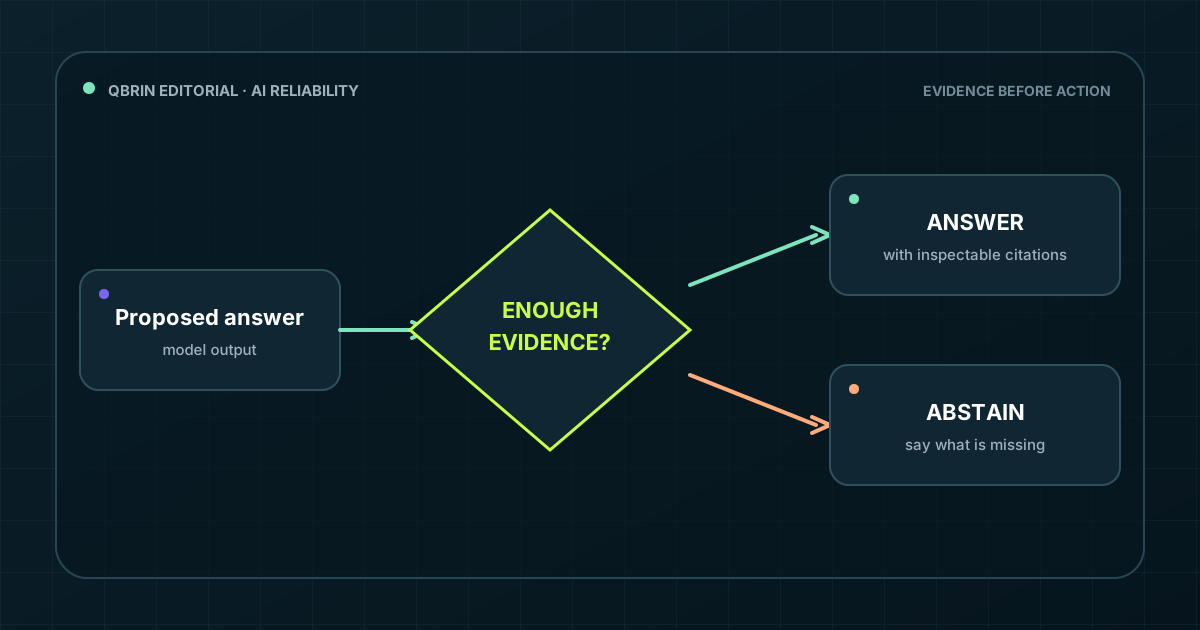
A system that always answers is easy to demo. It is also being forced to speak in the exact cases where its evidence is weakest.
Abstention is the controlled alternative: the system declines, narrows the response, asks for missing context, or escalates rather than inventing a bridge across an evidence gap. In high-stakes work, that is not a missing feature. It is the behavior that keeps uncertainty from masquerading as fact.
The real trade-off is coverage versus false acceptance
Teams often optimize for answer rate: what percentage of questions received a response? That metric is incomplete. A high answer rate can be purchased by answering questions whose correct answer is absent from the source material.
A better view tracks at least four outcomes:
| Outcome | What happened | Operational meaning |
|---|---|---|
| Supported answer | The claim is backed by inspectable evidence | Useful coverage |
| Correct abstention | The source does not support an answer | Risk avoided |
| False acceptance | An unsupported answer passes | The dangerous failure |
| False rejection | A supportable answer is withheld | Lost usefulness |
The right threshold depends on consequence. A lunch recommendation can tolerate more coverage. A production change, clinical workflow, or mission command needs a much lower false-accept rate.
What qbrin's benchmark says
The June 2026 first-party qbrin Benchmark Report includes 301 multi-hop questions with no valid answer. It reports a 5.3% false-answer rate for qbrin, compared with 20.3% for traditional RAG, 17.6% for hybrid RAG, and 18.9% for a reranking baseline. The report summarizes that result as roughly four times safer than traditional RAG on this particular test.
That is useful evidence, but its scope matters. The suite is qbrin's own, competitor figures are described as published numbers or like-for-like reruns, and results on a new corpus can differ. The claim to carry forward is narrow: on the reported unanswerable set, qbrin allowed fewer fabricated answers through.
A good abstention is specific
“I can't help with that” is not a useful enterprise response. A well-designed abstention tells the user why the answer stopped and what would unblock it.
Weak: “I don't know.”
Useful: “The connected policy documents mention the standard refund window, but I found no approved exception for this account. I have not authorized the refund. Ask the account owner or connect the signed exception.”
The second response distinguishes missing evidence from missing permission. It exposes the boundary instead of hiding behind model language.
Abstention needs a recovery path
Every stop should map to one of a few actions: retrieve a more authoritative source, request a specific field, wait for fresher telemetry, ask a named reviewer, or remain stopped. The interface should preserve the evidence already gathered so the next person does not restart the investigation.
For physical systems, qbrin's existing PX4 and Gazebo simulation illustrates the pattern: incomplete evidence produced HOLD; when the evidence recovered, the simulated mission continued. That is a recorded simulation, not a claim of a certified aerospace deployment.
How to set the threshold
Start with consequence, not a universal score. Define what counts as support, what sources are authoritative, how fresh they must be, which contradictions force review, and how much delay is acceptable. Then test answerable and deliberately unanswerable cases together.
Track coverage, answered accuracy, false acceptance, false rejection, time to recover, and the fraction of abstentions a human can resolve. A trust layer that simply refuses everything is safe but useless. The goal is calibrated usefulness: answer when the record earns it, stop when it does not.
An abstention is not the absence of a decision. It is the decision that the current evidence does not justify crossing the boundary.
Comments
Sign in with GitHub to reply. Threads live in a public repository, so anyone can read them without an account.