 qbrin
qbrinIndustrial & physical AI · 2 of 3
Manufacturing AI needs a verification layer between insight and control
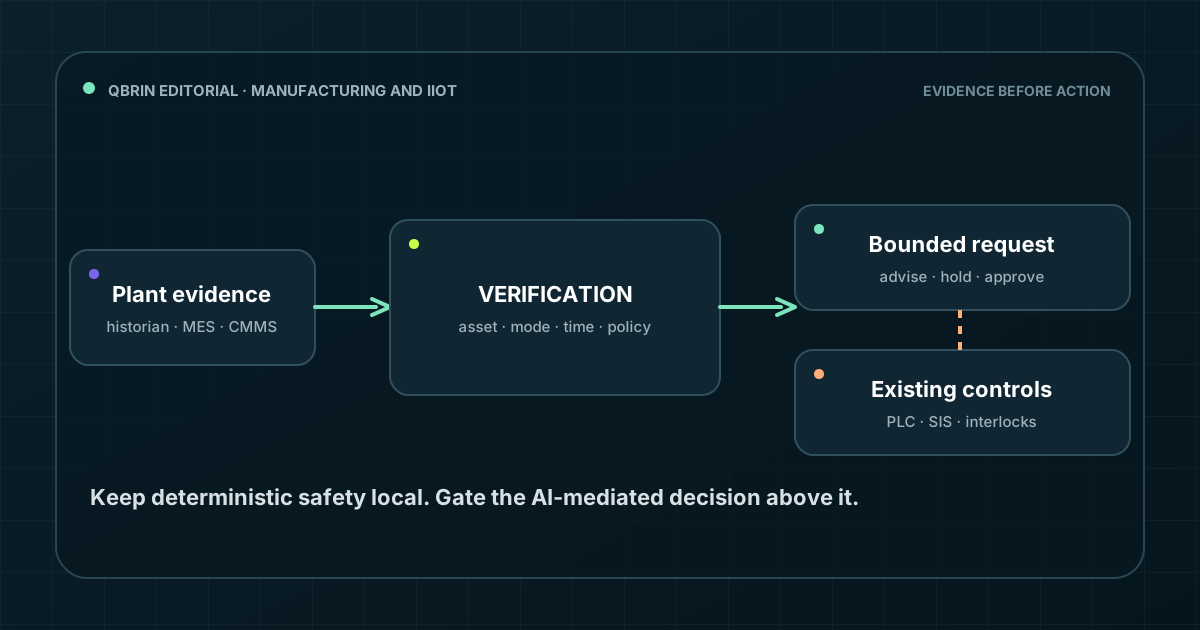
Industrial systems are very good at executing valid commands. They are not designed to decide whether an AI agent had a good reason to issue one.
A PLC can enforce interlocks, ranges, and sequences. A historian can record values. An MES can track production. The missing layer appears when a probabilistic system interprets that context and proposes a change: which evidence supports the proposal, and does this identity have authority to make it?
Put the boundary above deterministic control
Fast protection loops, safety instrumented systems, and certified controller logic should remain deterministic and local. A trust layer is better suited to supervisory decisions around them: work-order creation, maintenance recommendations, quality holds, recipe selection, energy scheduling, alarm triage, and bounded setpoint proposals.
The AI can reason over context. The plant's existing controls remain authoritative. The verification layer decides whether the contextual premise is supported and whether the requested action is inside policy.
A reference flow for an IIoT decision
- Bind the request to the asset, line, batch, recipe, operating mode, and time window.
- Retrieve evidence from approved sources: historian, CMMS, MES, quality records, manuals, and change logs.
- Verify the diagnosis and the conditions required by the procedure.
- Classify the proposed action by risk and reversibility.
- Apply identity, site, shift, and approval policy.
- Return ADVISE, HOLD, DENY, or a narrowly parameterized action request.
High-value starting points
| Use case | Why it fits | First safe mode |
|---|---|---|
| Maintenance triage | Evidence spans alarms, manuals, history, and parts | Rank causes with citations; human creates work order |
| Quality investigation | Claims depend on batch, recipe, inspection, and change context | Propose a hold with the supporting record |
| Energy optimization | Recommendations need production and equipment constraints | Simulate schedule changes; no direct control |
| Operator assistance | Procedures are useful only when version and mode match | Answer with exact step and source |
| Supervisory setpoints | Potential value is high; consequence is higher | Shadow recommendations and require approval |
Why existing interlocks are necessary but insufficient
An interlock can stop pressure from exceeding a limit. It may still accept a command that is syntactically valid, within range, and wrong for the operating objective. qbrin's published water-treatment experiment and power-grid experiment are designed to illustrate this gap: the underlying control systems can carry out commands that fit their mechanics without judging the agent's evidence or intent.
Those are controlled experiments, not field-deployment claims. Their value is conceptual: process protection and epistemic authorization solve different problems.
Industrial evidence has shape
Plant claims are not supported by text alone. A useful evidence bundle may include a time series, event sequence, equipment hierarchy, calibration state, unit of measure, maintenance revision, operator note, and production context. The trust layer has to preserve those relationships rather than flattening every signal into prose.
Freshness should be typed. A manual may remain authoritative for months; a vibration reading may expire in seconds. A batch disposition may require two signatures. A verifier that ignores these semantics can produce a beautifully cited wrong recommendation.
Start in shadow mode
Choose one line and one decision class. Let the system observe approved data and produce a proposed action plus evidence, but do not connect it to control. Compare its proposals with operator decisions, especially during changeovers and abnormal situations. Count unsupported claims, missed conditions, false holds, and time saved.
Then add a human approval workflow with a narrow action envelope. Preserve a hard separation between the AI's reasoning, the trust decision, and the controller's safety logic. Expansion should follow measured performance and site governance—not pressure to announce autonomy.
The industrial opportunity is not an AI that can touch every control. It is an AI whose reasons, permissions, and limits are clear before it touches any.
Comments
Sign in with GitHub to reply. Threads live in a public repository, so anyone can read them without an account.