 qbrin
qbrinWhen an absence becomes a finding
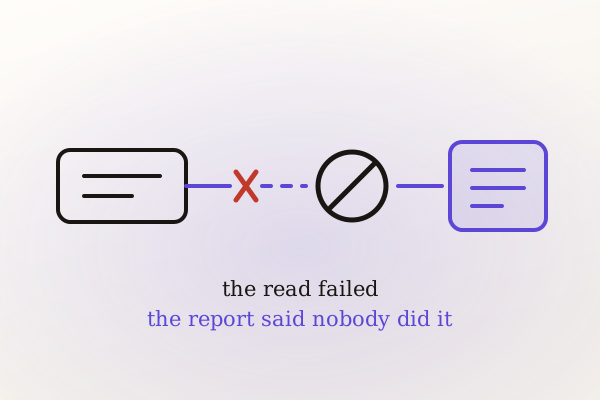
Two sentences can look identical on a dashboard and mean opposite things.
“No one on the team closed a task this quarter.”
“The query for closed tasks failed.”
The first is a finding. It travels. Someone forwards it, someone schedules a meeting about it, someone forms a view about a colleague. The second is a bug report, and nobody would forward it anywhere except to an engineer.
These two sentences are produced by the same code path more often than most teams realise. This post is about that path: how a read that failed becomes a claim about the world, why the usual test suite never sees it, and the one rule that removes the whole class.
The mechanism
Almost every data access in a modern system can end in three different states, and almost every system stores them in two.
| State | What actually happened | What it is usually stored as |
|---|---|---|
| Not asked | The read was skipped, gated, or never reached | [] |
| Asked and failed | Timeout, permission denial, bad key, malformed row | [] |
| Asked and genuinely empty | The question was answered: there is nothing | [] |
Only the third state carries information about the world. The first two carry information about the system. Collapse them into one empty array and you have quietly promoted an infrastructure event into a fact.
Nothing downstream can undo that. The consumer receives a well-formed, entirely plausible empty list and does the reasonable thing with it: reports zero, draws a flat line, writes a sentence. The error is not in the consumer. By the time the value arrives, the evidence that would have prevented the mistake has already been thrown away.
Why a language model makes it worse
Hand an empty result set to a traditional report and you get an empty table. A reader sees the blank and is appropriately suspicious of it. Blank space is honest about itself.
Hand the same empty result set to a language model and you get prose. The model is not lying and it has not hallucinated anything: it is doing exactly its job, which is to write the most plausible sentence consistent with the context it was given. The most plausible sentence consistent with an empty context is a confident negative claim.
An empty table invites a question. A fluent paragraph closes one.
This is why the bug class became far more expensive in the last two years than it ever was before. The natural-language layer is a confidence amplifier sitting directly downstream of the exact place where systems discard the difference between “nothing” and “no answer.” It converts a missing value into an assertion, in the register of an analyst, with no visible seam.
Three shapes it takes
It is worth recognising the specific silhouettes, because they look different at the call site and identical in the output.
1. The failed read. A secondary lookup — relationships, permissions, an enrichment join — throws. It is wrapped in a try that returns a default so the page does not crash. The page does not crash. It now states, of every record it displays, a property it was never able to check.
2. The cap that empties a category. A limit is applied to a ranked list to keep a payload small. This is correct reasoning for a list and wrong for anything grouped. Cutting a ranked list at N does not shorten each group proportionally; it deletes whichever groups sort last, entirely. If the ranking happens to put finished work at one end, a truncated read produces a board with an empty “done” column, and a summary that says nobody has finished anything. The cap was a performance decision. It arrived as a judgement about people.
3. The key that never matches. Two spellings of one field name, a renamed column, a class name that was never defined. Nothing errors. The lookup simply never matches, forever, and returns its empty default at every call. This one is the most durable, because there is no failure event anywhere for a monitor to catch. It is a permanent, silent, well-formed zero.
Why the tests pass
Test suites are written against fixtures, and fixtures are populated. That is the whole problem in one sentence.
An engineer writing a test for a summary function reaches instinctively for representative data, because the interesting assertions are about representative data. The empty case, when it is written at all, tends to assert the shape of the output rather than its honesty: it checks that the function returns a string and does not throw. Both hold perfectly for a sentence that is confidently false.
And the empty case is not one case. It is three, and the test writes only the benign one. There is rarely a test that asserts: when the underlying read fails, this function must not produce a negative claim. That assertion feels strange to write, which is a reliable signal that it is the one worth writing.
The rule
Everything above collapses into a single constraint, and it is worth stating in the imperative because it is checkable:
An absence may be rendered as a finding only if the read that produced it succeeded.
Which means the read has to carry that fact with it. Not in a log line, not in a metric, not in a comment — in the return value, where the consumer cannot avoid it. A read returns a status alongside its rows, and every layer that turns rows into language is required to branch on it. “Nothing found” and “could not check” must be different sentences, all the way to the screen.
There is a corollary that saves a great deal of time: fix the producer, not the third consumer. When a shared function silently drops the state, every surface built on it develops the same defect independently, and each one gets patched separately by whoever notices it. Three patches, three code paths, one unfixed cause, and a fourth surface tomorrow. If you find yourself writing the same defensive check in a second place, the bug is upstream of both.
How to find them, cheaply
Static review is poor at this, because the code reads correctly at every individual site. The defect is not in any one function; it is in the seam between them.
The technique that actually works is embarrassingly simple. Run the real system against real data, and read every sentence it produces containing a negative. Nobody. None. No records. Zero. Has not. Each one is a claim that something was checked and found absent, and each one is worth pulling the thread on until you have seen the read that justifies it.
Sorting a page by the strength of its negative claims is a faster path to real defects than any amount of coverage tooling, because a system that is silently blind reports its blindness as certainty, and certainty is greppable.
Why this shapes the way we build qbrin
qbrin is a trust layer for enterprise AI, and this bug class is precisely the thing a trust layer exists to make impossible. An answer that reads as authoritative because the evidence behind it never loaded is indistinguishable, to the person reading it, from an answer that is right.
So the architecture treats not-knowing as a first-class output rather than a fallback. Retrieval reports whether it ran, not just what it returned. Verification gates ask whether each claim is supported by evidence actually present, and an unsupported claim blocks the answer rather than decorating it. When the system cannot ground a statement, it says so and stops. We publish that cost honestly: on our audited held-out benchmark, qbrin answers about three quarters of questions rather than nearly all of them, and that gap is the deliberate price of never inventing the remainder.
The abstention is the feature. A system that cannot say “I could not check” will eventually tell you, fluently and with total confidence, that there was nothing to find.
Comments
Sign in with GitHub to reply. Threads live in a public repository, so anyone can read them without an account.